
THIS IS NOT THE CURRENT EDITION OF THE OAT UPDATE
Browse all OAT Updates
Issue Contents
New Announcements
Reminders
Missed an update? Browse all OAT Updates
New Announcements
VoiceThread Tip: Collect Student Comments on Lecture Videos
Often in an online class, the instructor will create and post a lecture video and require students to watch the video and provide some kind of comment or response. Those responses are then tracked and graded. The issue is how to efficiently keep track of who has submitted the required comment and what grade should they receive?
Let's cut to the chase: VoiceThread is a great tool for this kind of assignment.
Using a Commenting Assignment
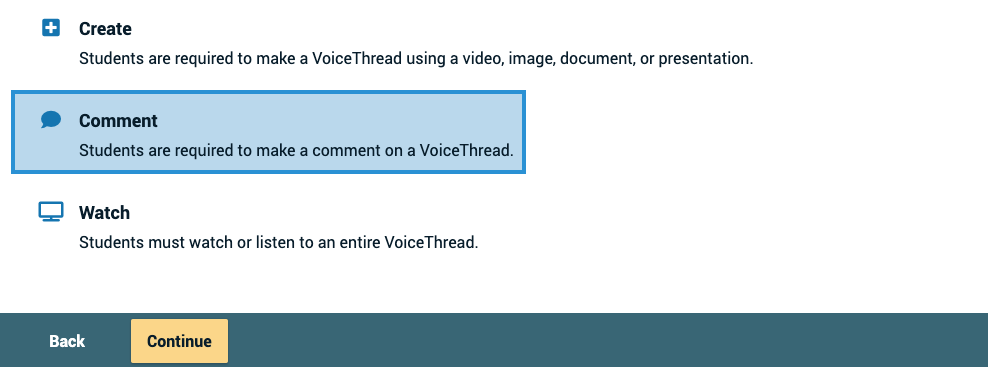 The Commenting assignment is one of three assignment types offered by VoiceThread. It's also the one that is best suited to capturing student responses to a lecture video. Additionally, by enabling comment moderation, comments can be made "private" between student and instructor, or left "public" for the whole class to see and respond to.
In this assignment, you will create a new VoiceThread presentation and upload your video file as the content. Specify how many comments they're required to make and whether the comments will be public or private. That's it! Then, the students watch the video and respond to by leaving their comments directly on the time line of the video. Their comments can be typed text or multimedia (audio and video).
Later, the instructor returns to the activity and views the comments of each student in VoiceThread and assigns a grade. The score is automatically transferred back to the Canvas grade book.
Questions? Contact OAT!
Return to top
Award Partial Credit in New Quizzes Multiple Choice Questions
In the New Quizzes tool in Canvas, you can set up a multiple choice question that awards different point values depending on the answer chosen. In other words: partial credit can be offered.
 In the settings of the question, open the "Options" section. Then, check the box for Vary points by answer. Finally, configure the point values for each of the answers.
Learn more
Return to top
Turnitin AI Detection
The Office of Academic Technology will be renewing its subscription to Turnitin, including the AI writing assessment feature. The AI assessment determines the percentage (if any) of the submitted text that was written by AI. The AI score of a submission is visible to instructors only, and students are never shown it. Though the AI assessment tool has been shown to have a very high accuracy, Turnitin is transparent that it may not always be accurate (it may misidentify both human and AI-generated text). For example, low AI scores have a higher likelihood of false positives, especially on short text passages (< 300 words).
Importantly, like the Similarity score, the AI assessment only provides data and is pointedly not making a determination about student misconduct. As such, it should not be used as the sole basis for adverse actions against a student. Overall, it takes further scrutiny and human judgment in conjunction with an organization's application of its specific academic policies to determine whether any academic misconduct has occurred.
Here are three tips for addressing AI writing in your class.
- State expectations up front. (See below for a syllabus statement tool.) How you address AI usage by your students falls on a continuum of permission, ranging from allowable on all assignments to disallowed on all assignments. Perhaps AI usage is permitted on some assignments with appropriate citation or for some parts of the assignment (not including a final submission). The guardrails are completely up to you, but communication with your students is key.
- If there is a concern about a particular submission, gather artifacts of previous writing as part of the conversation with the student. Artifacts such as previous drafts or even previous assignments can clearly demonstrate the student’s own voice or writing style. Having this information can help determine if the AI score is a problem or not.
- Prepare for false positives. Though the risk of false positives is low, especially for long submissions, it can't be discounted entirely. Read more about how to handle conversations with students after submission, including the importance of assuming positive intent on the part of the student even if uncertainty remains on the part of the instructor.
Return to top
Generative AI Syllabus Statement
The discussion of AI in education has taken two paths. In one, instructors are exploring how they can actively incorporate some aspect of AI into their teaching and their course design. In the other, instructors are concerned about how students should be allowed (or not) to use AI in their course work.
Providing a statement about AI usage in the course syllabus is important in both cases. The following tool developed by Chris Heard at Pepperdine University aims to help you craft a draft of a statement that works for you.
Generative AI Syllabus Statement Tool
Return to top
Reminders
Moodle End-of-Life Time Line
At the conclusion of the spring 2024 term, OAT will begin winding down the Moodle server currently being hosted by OIT. The following timeline was approved by the Academic Technology and Learning Committee on 02/19/24.
- No active courses will be allowed on the platform following spring 2024.
- Moodle will remain available for users to login for document retrieval, grade book retrieval, course backup, etc. through May 31, 2025.
- Moodle will be shut down and unavailable on June 1, 2025.
Return to top
Canvas Did-You-Know?
Here are three common items that you might not have known about using Canvas.
1. Custom courses
All instructors can create empty, blank Canvas courses at any time for any purpose. No need to request one from OAT!
Simply click "Start a New Course" on your Dashboard and enter a name for the course. That's it! Your new course is as functional as any other Canvas course, though you must manually enroll other people into it using the People page.
2. User Enrollment
All instructors can generally enroll any other Stan State user into their course from the People page. Just supply the person's email address and specify the role they should have in the course.
Note: Enrolling students into an official course shell may be overridden by the PeopleSoft enrollment data for that section. For example, this will happen if the student had previously been enrolled in the section but then dropped. In that case, the manual enrollment will be overridden by the hourly PeopleSoft update and the student will lose access to the course. To remedy this situation, contact OAT.
3. Merging Sections
Often at the beginning of the semester, instructors wish to combine the enrollments of multiple courses or sections in Canvas. This allows them to post content one time but have it viewable by all their students.
Interested? Learn how to do this.
Note: To adhere to FERPA, students in merged sections in Canvas will not be able to see students outside their own section. If appropriate for a given situation, that restriction can be removed. Contact OAT for assistance.
Return to top
(Waitlist Forming) Introduction to AI Tools For Teaching & Learning
The following professional development opportunity is being offered by the Online Course Services division of the CSU Chancellor's Office.
Introduction to Artificial Intelligence tools where guided experimentation empowers participants to understand some of the basics of AI functionality, including its workings and methods for detecting its usage. Learn basic AI terminology, engage in hands-on exploration of AI Tools, learn strategies for detecting AI-generated content, and techniques to address potential misuse of AI tools by students. Participants will apply the knowledge gained to develop a personalized AI use policy for their course, and find resources to maintain currency in this dynamic field.
Course Commitment: 3 weeks, 20-25 hours, online, asynchronous. Seating is limited due to high demand, so register early.
Dates Offered:
Feb 26 – Mar 17, 2024 (Spring 2024)
Mar 25 – Apr 14, 2024 (Spring 2024)
Syllabus
Register for the waiting list
Return to top
Informal QLT Course Assessments for Winter and Spring Courses
All instructors who are teaching asynchronous online courses in Winter and Spring are invited to have their course informally assessed using the QLT rubric. QLT consists of 52 'objectives' spread across 9 categories of best practices in online course design. It was assembled by a collection of CSU instructional designers and faculty members and was most recently updated in 2022.
After requesting an assessment, OAT will review the course with the QLT rubric and send the feedback to the instructor only. A follow-up consultation to discuss the assessment can be scheduled if desired. This is a great way to get a second pair of eyes on your course for constructive feedback!
Email oatsupport@csustan.edu and specify which course you're interested in. Content should be in a regular Canvas shell.
Additional links:
Return to top
Canvas Support Options
All Canvas users have access to various support options when questions or problems arise.
Instructors
Options for instructors are:
- Call Canvas support 24x7 (open Help menu)
- Chat with Canvas support 24x7 (open Help menu)
- Email oatsupport@csustan.edu
- Review online documentation
In general, the OIT Tech Support desk cannot help with Canvas issues - all Canvas administration is handled by OAT and it is best to start with one of the options listed above.
Students
Students can get basic support in these ways:
- Chat with Canvas support 24x7 (open Help menu)
- Review online documentation
Any issue that cannot be solved by Canvas support will be redirected to OAT for further assistance.
Return to top
Ally Accessibility Gauges
Ally is the automated accessibility checking tool that is installed within Stan State's Canvas system. This tool makes it easy to spot accessibility issues with your course materials and ensure access for all students. There are two main purposes of the Ally tool:
- Scan every piece of content/document/image in a course and gauge its accessibility. Instructors are then guided through steps to address the accessibility issues. The severity of issues (and the lack of issues at all!) are indicated by a color-coded system of gauges.
- Provide students with alternate formats for most content, and even language translations in some cases. Alternate formats may be PDF versions of documents, spoken audio versions of documents, etc.
Gauge Colors & Access
Ally uses a small gauge icon next to each piece of content or image to represent its accessibility status. The colors correspond to those on a traffic stop light:

The gauges are only visible to instructors. Students never see the accessibility status of an item. Instead, they only see a small "download" icon next to each item that allows them to access alternative formats for the item.
More Information
Learn more about Ally and accessibility.
Return to top